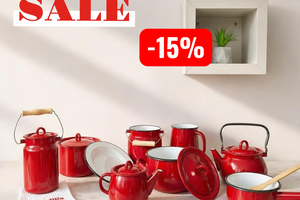
Enameled cookware is beautiful, durable, and easy to use. Thanks to its durable glassy layer, the metal doesn't rust, and food doesn't come into contact with it. However, even the highest-quality cookware can develop chips, cracks, or even small holes over time, usually due to burn-through. Is it possible to repair and restore a pot, or is it better to buy a new one? To answer this question, you need to understand what enamel is.
When is it worth restoring enamel, and when is it best to replace it?
Enamel is a special vitreous coating created by high-temperature firing of a powder mixture onto a metal surface.
Enamel is created from a mixture of quartz sand, kaolin, feldspar, borax, and special additives. These components are melted at temperatures above 1000°C, after which the material is cooled, crushed, and ground into a powder called enamel frit. This frit is then applied to the steel workpiece as a slurry.
Next, the cookware is fired at approximately 800–850°C. At this point, the powder transforms into a vitreous film that firmly adheres to the metal. Different compositions can be used on the inside and outside of the piece: inner enamel is more resistant to acids and alkalis, while outer enamel is designed to withstand fire and high temperatures. This process is used to produce any type of enamelware, whether pots, bowls, teapots, or enameled food containers.
If only the outer surface is damaged, you can try cosmetic repairs using a special putty or varnish. This will preserve the appearance and allow the cookware to continue to be used.
However, if the inner surface is seriously damaged, especially at the bottom, it is unsafe to use such cookware. The enamel layer acts as a protective barrier. Its absence means that food will react with the metal, altering the taste and risking the ingress of harmful compounds into the food.
Restoring the enamel inside a pot or teapot is impossible at home. Even if you manage to temporarily repair the damage, it will peel off when heated, so it's best to replace any cookware with chips inside.
Main Causes of Chipping and Damage to Enamel
Why do chips occur? The main causes are strong impacts or sudden temperature changes. Since the expansion coefficients of the metal and the vitreous layer differ, sudden temperature changes can cause the enamel to crack, resulting in a chipped edge.
The main causes of enamel failure are:
thermal shock—when a hot pot or teapot is placed under cold water, or when an empty pot is overheated on the stove;
drops and impacts on the sides, which cause chipped pieces of the coating;
using hard metal sponges and abrasive powders, which can cause scratches.
If the enamel surface loses its integrity, small defects appear, which, with continued use, lead to further damage to the coating.
Methods for Restoring Enamel
There are several methods for home repairs:
- Patching chips with epoxy mixtures or special enamel varnish;
- Sealing external defects with heat-resistant pastes;
- Applying ceramic or polymer compounds for temporary protection.
- All of these methods are suitable only for the exterior surface, which does not come into contact with food. Home restoration is only possible as a cosmetic measure to make the pot or kettle look neater.
Restoring Enamel Inside Cookware: Features and Safety Precautions
The interior enamel coating cannot be restored at home. When sealed or sealed, the applied compound will quickly deteriorate, and food will come into contact with the metal during heating. Moreover, chemical components from the mixtures used may leach into the food.
Therefore, it is important to remember:
Cookware with chipped enamel inside loses its protection;
Any attempts to restore it from the inside for further use pose health risks;
Use such a pot or kettle. In this case, it's best to replace the item. If you have the receipt and the warranty from the Novomoskovsk Tableware Factory (Idilia) is valid, an exchange is possible.
Care Tips for Longer Enamel Life

To enjoy your enamelware for many years to come, simply follow these simple care rules:
- Heat it gradually, don't place it directly from a cold surface onto a hot stove;
- Avoid impacts and drops, handle the lid carefully;
- Wash only with soft sponges and liquid detergent;
- Do not store food inside for long periods of time, especially acidic foods;
- Keep the cookware dry with the lid open;
- Use wooden or silicone spatulas that won't scratch the enamel.
Following these recommendations will extend the life of your enamelware for many years and help maintain its beautiful appearance.
Enameled cookware combines aesthetics and practicality, but requires careful handling. Repairs and restoration of the coating are only possible for external damage as a temporary measure. If the inner surface has a chip or crack, restoration is not possible - in this case